Hunting success and efficiency of an urban Peregrine Falcon (Falco peregrinus) during the low light season in south-west Norway
DOI:
https://doi.org/10.15845/on.v48.3625Keywords:
hunting success, hunting efficiency, Jackdaw, Peregrine, urbanAbstract
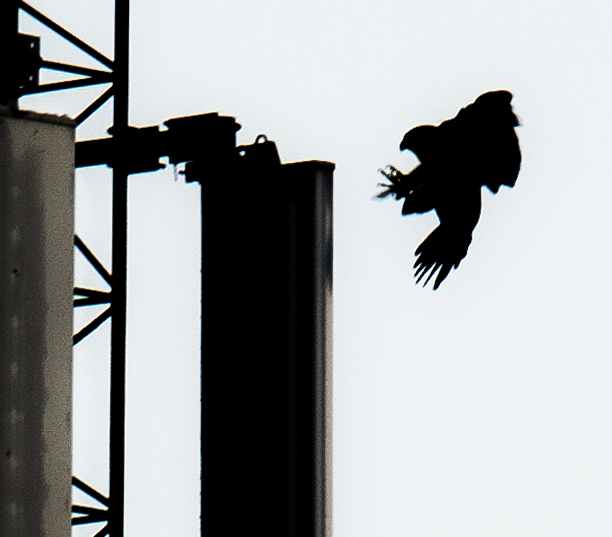
Cover photo: A Peregrine Falcon Falco peregrinus landing on a radio antenna. Photo: Bjarne Emil Time.
In November-December 2019, a Peregrine Falcon Falco peregrinus hunted close to the center of Bryne, a small town in southwest Norway. During winter, several thousand corvids normally roosted together in the city’s park area. The hunts took place in the dark, after sunset and before sunrise. In this 30-day study, the falcon used a sit-and-wait strategy to hunt roosting corvids. The hunt started each time from the top of a 43 m high antenna near to the park and my apartment. The falcon then brought prey items to a balcony on a tall office building in the city centre, and to the same plucking and eating site after each kill. Sensitive cameras documented the activity of the falcon and its prey which were always Jackdaws Corvus monedula. One camera was mounted by the antenna and two cameras were deployed on the balcony. The attacks were registered as successful if the falcon returned with prey, or otherwise as unsuccessful. The falcon made a total of 42 attacks. A subset of 18 attacks ended with a return to the balcony, of which 13 were successful, resulting in a hunting success of 31% (13/42). Overall, 54% of all kills occurred in the dark before sunrise, and most of the prey were killed in December (77%). The ratio of time spent on successful hunting to total hunting time was 79 to 308 minutes, giving a hunting time efficiency of 26%. On average, the falcon used 6 minutes per successful kill, with a range between 1 to 16 minutes.
References
Buchanan JB & Herman SG. 1986. Success rates of the Peregrine Falcon (Falco peregrinus) hunting Dunlins (Calidris alpina) during winter. Raptor Research 20: 130–131.
Cade TJ. 1982. The Falcons of the World. Cornell University Press, Ithaca, New York.
Decandido R & Allen D. 2006. Nocturnal hunting by Peregrine Falcons at the Empire State Building, New York City. Wilson Journal of Ornithology 118: 53–58.
Dekker D. 1980.Hunting success rates, foraging habits, and prey selection of Peregrine Falcon migrating through Central Alberta. Canadian Field-Naturalist 94: 371–382.
Dixon N & Drewitt JA. 2018. A 20-year study investigating the diet of Peregrines, Falco peregrinus, at an urban site in south-west England (1997–2017). Ornis Hungarica 26: 177–187.
Lindberg P. 1975. Pilgrimsfalken i Sverige. Svenska Naturskyddforeningen, Stockholm.
Nygård T, Sandercock BK, Reinsborg T & Einvik K. 2019. Population recovery of Peregrine Falcons in central Norway in the 4 decades since the DDT-ban. Ecotoxicology 28: 1160–1168.
Ratcliffe D. 1993. The Peregrine Falcon. T & A D Poyser.
Rejt L. 2001. Feeding activity and seasonal changes in prey composition of urban Peregrine Falcons Falco peregrinus. Acta Ornithologica 36: 165–169.
Roalkvam R. 1985. How effective are hunting Peregrines? Raptor Research 19: 27–29.
Shimmings P & Øien IJ. 2015. Bestands estimater for norske hekkefugler. Norsk ornitologisk forening (NOF). Rapport 2–2015.
Svorkmo-Lundberg T, Bakken V, Helber M, Mork K, Røer JE & Sæbo S. 2006. Norsk VinterfuglAtlas. Norsk Ornitologisk Forening (NOF).
Time BE. 2016. Hunting activity by urban Peregrine Falcons (Falco peregrinus) during autumn and winter in south-west Norway. Ornis Norvegica 39: 39–44.
Treleaven RB. 1980. High and low intensity hunting in raptors. Zeitschrift für Tierpsychologie 54: 339–354.
Zoratto F, Carere C, Chiarotti F, Santucci D & Alleva E. 2010. Aerial hunting behaviour and predation success by Peregrine Falcons Falco peregrinus on Starling flocks Sturnus vulgaris. Journal of Avian Biology 4: 427–433.
Downloads
Published
How to Cite
Issue
Section
License
Copyright (c) 2025 Bjarne Emil Time

This work is licensed under a Creative Commons Attribution 4.0 International License.
Articles published prior to September 2020 are subject to the following terms: https://boap.uib.no/index.php/ornis/copyright