The Lost Child

Authors

  • Rolf Erik Scott SOT-Film AS, Department of Social Anthropology, University of Bergen. 
  • Olaf Smedal Department of Social Anthropology, University of Bergen

Keywords:

Indonesia, Ngadha, Ritual, Sacrifice, Divination, Hierarchy, Hypogamy

Abstract

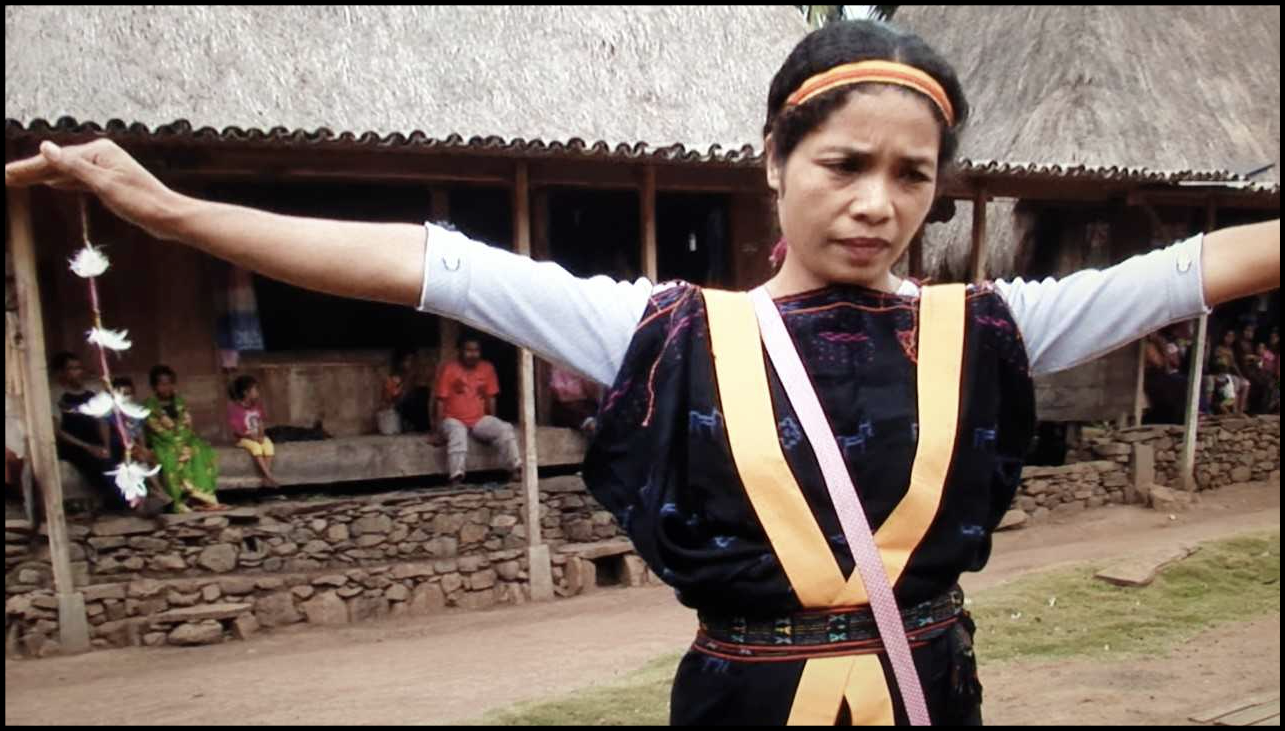
This film chronicles a two-day rite of passage known as Nuka Nua, or ‘Returning to one's home village’ among the Ngadha people in central Flores, Indonesia. Nine years earlier, Ludis, a noblewoman and nurse, secretly married her beloved, Anis, a schoolteacher and commoner. In their society, women preserve the noble lineage, which is severed through hypogamy (marrying beneath one's status), once punishable by death. The couple have two children and Ludis has been exiled from her village since their marriage. 

Ludis's aging parents, Bene and Sofie, have been longing to spend time with their only adopted child and grandchildren. However, a family reunion can only occur after Ludis and Anis have passed through a harrowing rite of passage that cleanses them and transforms Ludis from a noble woman to a commoner. This ritual of death and rebirth is prohibitively expensive, forcing the eloped couple to endure a long wait before it could be arranged. The film shows how two fundamentally different ideological constructs clash. One manifests as a social organization characterized by hereditary rank based on notions of purity; the other echoes more egalitarian notions. The first is rooted in the cosmo-mythical past; the second is grounded in a much more recent discourse. Social organization premised on rank and purity is rapidly losing ground– in part due to the influence of ‘the modern’, but even more so because its own internal logic works against it.

Warning: This film has scenes showing the sacrifice and slaughter of animals.

Author Biographies

Rolf Erik Scott, SOT-Film AS, Department of Social Anthropology, University of Bergen. 

Rolf E. Scott (PhD) is a researcher in the department of Social Anthropology, University of Bergen. His research focuses on the phenomenology, history and dynamics of global spaces, based on the idea that the global grid system of longitude and latitude forms the foundations for modern understandings of both the individual and the global. This includes how this system emerged and shapes modern understandings of existence, and how it affects the lives of individuals and groups. Rolf’s fieldwork includes the study of global practices, including Western individuals who sail around the world, the revitalization of Polynesian navigation systems, and film– with a particular focus on how this medium can be seen as a virtual aspect of a global grid-based space. He has made a range of anthropological documentary films from around the world. Previous films published in JAF include: Vincent and the Rainforest: Global Conversations in Rural Melanesia (2023); Tuo Dolphins (2023); Alfred Melotu, The Funeral of a Paramount Chief (2022); Going for Mackerel (2020); Cheas Great Kuarao (2018); and The Go Between, Afar of Ethiopia (2019).


Olaf Smedal, Department of Social Anthropology, University of Bergen

Olaf H. Smedal (PhD 1994, University of Oslo) is Professor Emeritus in the Department of Social Anthropology, University of Bergen. Nearly five years of field research in Indonesia have resulted in his book Order and Difference (1989), as well as multiple publications on social organization, kinship, language, value hierarchies, economic change and aesthetic expressions among the Lom or Mapur in Bangka (western Indonesia) and the Ngadha in central Flores (eastern Indonesia). Olaf co-edited the Norwegian-language textbook Mellom himmel og jord: Tradisjoner, teorier og tendenser i sosialantropologien (2000, with Finn Sivert Nielsen) and contributed to the first anthology on kinship in Norway, Blod—tykkere enn vann? (2001). With Knut M. Rio, he edited Hierarchy: Persistence and Transformation in Social Formations (2009), and has been editor of the Norwegian Journal of Anthropology. At present he is pursuing research on migration processes in Indonesia and on the local effects of the massive political and economic changes in the country since the fall of President Suharto in 1999. He further discusses the nuka nua ritual in his article, ‘Demotion as Value’, published in the journal Social Analysis.

Downloads

Published

2025-12-17

How to Cite

Scott, R. E., & Smedal, O. (2025). The Lost Child. Journal of Anthropological Films, 9(02). Retrieved from https://boap.uib.no/index.php/jaf/article/view/4061

Issue

Section

Films